Showing posts with label Izzy Sparber. Show all posts

Tuesday, March 13, 2012

SEYMOUR, IZZY, E.G. LUTZ, and "THE BIBLE"


This past January I posted several pages from the Standard Production Reference, the Fleischer Studios document developed by Seymour Kneitel and Izzy Sparber for in-house use. Often referred to as "The Bible," this is such an interesting piece of animation history I've now posted the complete document on this blog. To view it go to the black bar near the top of this page and click on “The Standard Production Reference.”


Some Background:
In my dad’s library there was a copy of the book Animated Cartoons by E.G. Lutz. Prior to the development of in-house animation manuals, such as the Standard Production Reference, Lutz was the first and most important book that existed on animation and how to do it. First published in 1920 it covers the early history of animated film, technical information,  details on how to animate people and animals in various activities… walking, running etc, plus ideas on how to create comedy on film. Below I’ve posted a few spreads from Lutz to give an idea of the book early animator's such as my dad used as a reference. (FYI: click on images to enlarge for reading)


To view more images and information about this very interesting Lutz book see Michael Sporn’s excellent discussion on his animation Blog:  http://www.michaelspornanimation.com/splog/?p=2812

Thursday, February 16, 2012

The Golden Age of 3D!


Could this be describing today? … No!…. What’s considered   ‘The Golden Age of 3D’ was actually from 1952 to 1955!

Film-makers have attempted to create the ‘illusion of depth’ since the earliest days of film. Experiments with 3D movies as we know them—with glasses—actually started as far back as 1897! But most attempts were for novelty, or impractical, and never got off the ground as a serious format for film until the 1950’s.


Patent drawing for invention of ‘set-back.’ Patent filed in 1933, and granted in 1936 to Max Fleischer. (click on to enlarge for viewing)
When Seymour worked as an animator at Fleischer Studios in the 1930’s they were using a completely different method to create the illusion of depth. It was technically called ‘the set-back’ and was used in many Fleischer films. This process, patented by Max Fleischer, involved building large miniature sets that sat on a turntable.  Painted drawings on clear celluloid sheets were placed in a special holder in front of the set. A special camera placed in front of the holder sequentially photographed each cell … after which the set was turned ever so slightly. When projected this created a terrific 3D effect… and in spite of considerable expense, was used in many Fleischer films. A number of other animation studios developed their own multiplane process with the same goal in mind—achieving a 3D effect. 


Photo: Dave Fleischer shown with 'set-back' for opening scene of Mr. Bug Goes to Town Fleischer Studios, released December 1941. Collection: Virgnia Mahoney


An interesting thing happened to the film industry in the early 1950’s. Movies had reached a low point in attendance--- television, an increasingly popular medium had taken away the audience! Attendance in theaters fell from 90 million in 1948 to 46 million in 1951. A favorite joke in our house was of a man standing at the box office asking what time the feature started, and the box office girl asking... "What time can you be here?" In 1952, just as theaters were desperately looking for something special they could offer the public, along comes the film Bwana Devil, the first popular 3D film in what would be referred to as 'The Golden Age of 3D.' Suddenly theaters could offer something TV could not...3D!!!


Poster for Bwana Devil explaining the 3D process, 1952 (click on to enlarge for viewing)
Collection: Virginia Mahoney


Bwana Devil was made in a dual strip process, which meant it required two projectors with a special motor to properly sync the projectors,  a special silver projection screen… and polarized glasses* worn for viewing. Most films made during this time used this process. Bwana Devil was hugely popular with the public. It not only brought the audience back to the theaters—it started a whole stream of 3D films that were made between 1952-55.

During this time Famous Studios made two animated 3D films, Popeye, The Ace of Space, (released 1953) and a Casper film, Boo Moon, (released 1954). To take advantage of 3D, both films used outer space as a setting.  The Popeye was directed by Seymour, and the Casper film by both Seymour and Izzy Sparber.


Advertisement for the Trade for Popeye, The Ace of Space. Famous Studios, 1953.
Popeye and Bluto are copyright 2011 King Features Syndicate, Inc. TM Hearst Holdings, Inc.
Collection: Virginia Mahoney
I remember going to the screening of the 3D Popeye film with my dad. He got a great charge out of the fact that the opening ‘gag’ in that 1953 film Popeye, The Ace of Space--- is the same ‘gag’ that had been used in the very first Popeye film made in 1933…. that of Popeye having to cross a great chasm by tossing a rope to the other side and pulling the other side to him. Re-cycling a good ‘gag’ was very common in those days. Popeye, The Ace of Space can still be seen at 3D Film Festivals today. 

Below is the Agreement between Famous Studios and Paramount Pictures dated July 1953 stating that during the contract period of 1953-54 Famous will make twenty four cartoons that will include both a Popeye and a Casper in 3D.

Here’s a 2D copy of the Casper film Boo Moon that was originally made in 3D. When Casper arrives on the moon the tiny inhabitants treat him like Gulliver…another bit of story re-cycling! You’ll also notice King Luna is a take-off on King Bombo from the earlier Fleischer Studio's film Gulliver’s Travels.

Boo Moon, starring Casper the Friendly Ghost, Famous Studios- released 1954. 
All character images are the copyright and trademarks of their respective owners. 


However, ‘The Golden Age of 3D’ was a passing fad, brought down by problems inherent in the 3D process used. The use of two projectors required them both to be exactly in sync—but film repairs due to tears, or even a sloppy projectionist could result in the two reels being out of sync, resulting in viewer headaches and eyestrain.  Also, the process required a special silver screen best viewed from the center with sideline seating often unusable. By 1955 3D was finished, and films using a wide screen format, that didn’t have these problems, were becoming popular. CinemaScope was to be the new fad.

3D periodically re-enters our lives. Some film historians see this occurring in 30 years cycles, pointing to ‘The Golden Age of 3D’ in the 1950’s, the brief 3D resurgence in the 1980’s (Friday the 13th Part 3, Amityville 3-D,  Jaws 3-D, etc.)– and in 2008 a new wave of 3D films started up again, energized by the release of the 3D film Journey to the Center of the Earth. 
The impetus behind this most recent 3D resurgence is again related to failing attendance at the box office. Since we can all now view large screen hi-def films in the comfort of our homes. theaters once again needed something unique to lure the public back. Again, the answer is 3D… this time enhanced with additional dazzling effects. When the film Avatar came out in 2009 it was released in 2D, RealD 3D, Dolby3D, Xpan 3D, and IMAX 3D. New and improved 3D films are suddenly abundant --- though so far we’re still wearing glasses…..

An interesting end to this story……Animation historian 
Michael Sporn has a post on his blog about Larry Riley who had worked at Fleischer Studios: 

"Larry also told of a 3D process he’d developed for Paramount in the 50’s when the movies were all going 3D…Larry offered to give me the camera on which he shot these films- he had it stored in his basement. He was afraid it would get thrown out when he died. I didn’t have room for it.” 
Larry’s grandson later told Michael another collector took the camera to keep it from destruction…. hopefully this bit of history is safely out there…somewhere….


*Most 3D viewing glasses during this time were polarized, with each lens the same gray tinted color- as opposed to the alternative type 3D glasses which have red/blue lenses.


Online References include:
Wikipedia
Odd Culture
Michael Sporn Animation
For the history of many amazing early 3D attempts see:
http://widescreenmovies.org/WoddCultureSM11/3D.htm


Tuesday, January 17, 2012

SEYMOUR, IZZY, and 'THE BIBLE' ...post 2


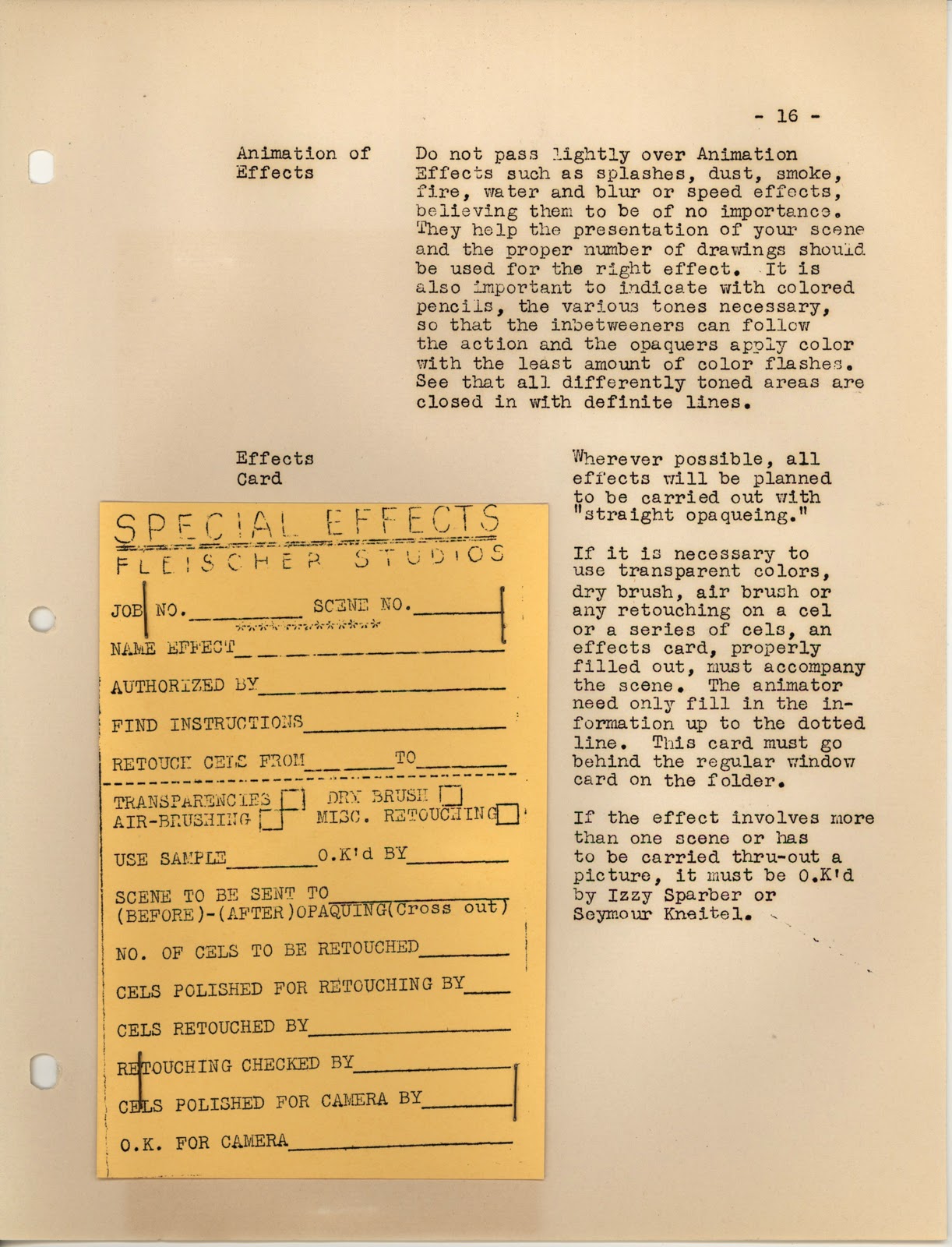
Here’s the second posting with another selection of pages from ‘The Standard Production Reference,’ often referred to as ‘The Bible.’ The previous post on this site talks about the history behind this document and also includes scans of some pages. The scope of this document reflects how complex the making of animated films had become, and the broad knowledge then required of animators.

This has a lot of technical information about how things were done…. the details of which may put some to sleep. This post is basically for the many fans who understand and crave these kinds of insights into early film production. But stay tuned…coming soon… posts of a more popular nature!

click to enlarge an image
Collection of Virginia Mahoney


Tuesday, January 10, 2012

SEYMOUR, IZZY, and "THE BIBLE"

Cover of "The Standard Production Reference," missing front label.
Collection of Virginia Mahoney
Cover label: Collection of J.J. Sedelmaier.
THIS JUST IN! J.J. Sedelmaier noticed I was missing the label on the cover – and sent me a scan of his label. What a gift! Now I know for certain the year it was first officially distributed…1940. Thanks J.J.!


This document, ‘The Standard Production Reference,’ often referred to as ‘The Bible’ was in use at Fleischer Studios by 1940. It was developed by Seymour Kneitel and Izzy Sparber for the use of “animator’s and their assistants.” Originally intended for Fleischer Studios staff it continued in use as the official manual for Famous Studios as well. The need for such a document shows how complex the industry had become since the animated films of the early 1900’s.

In a 1935 article published in Fleischer Animated News and written by animator Bill Turner, he reflected on the earlier less complex days of a fledgling animation industry…..

“All that was needed to go into business in those days was a Parker pen and pencil set. There were no separate departments, everyone working in one room about as large as a good sized doll house. Such departments as Music, Story, Timing and Background were unheard of....... The pictures were run on a portable projector against a wall. In place of a dark room, the camera magazines were loaded in a black bag or overcoat.”

By 1935 when Bill Turner wrote the above, the animation industry had evolved to a much higher level of complexity with separate departments for such functions as story, animation, inking, paint mixing, opaquing, background, timing and music. In addition the increasing popularity of animated films led to increases in staff size (when Fleischer Studios moved to Florida to make Gulliver’s Travels in 1938 their staff grew to over 700 employees). All this growth created a need to formalize procedures to insure an orderly flow of work within a studio.

Several studios developed some form of in house ‘manual’ to answer this need. The Fleischer Studios manual, ‘The Bible,’ is sixty-one pages long. In addition to detailing procedures, it provides sample jobsheets to accompany work as it moves through departments, includes guidelines for dealing with special effects, and information on the use and limitations of various special animation cameras (Approach, Large Field, Set-Back etc.), plus a myriad of other issues that are reflected in the index (below). Since ‘The Bible’ was such an excellent guide to animation production in general it was often used as a reference by other animation studios.

Animation historian Mark Langer notes that “… the Standard Production Reference later became a guide by which other animation companies were organized or by which they regularized production….. For at least thirty seven years after the demise of the Fleischer Studios, “The Bible” was the most commonly used reference work within New York animation studios.”

This is the first of two posts containing selected pages from that document.  These pages show how complex the animation field had become by 1940, and the broad knowledge now required of an animator. Next week I’ll post more pages … check the index (below) and if there’s a particular area not included here you would like to see let me know and I will oblige……. BTW: you can click on individual pages to enlarge for ease of reading.

Reference material:
Article: “The Good Old Bad Days” by Bill Turner - Fleischer Animated News,  Vol. 1 No.3, February 1935
Article: “Institutional Power and the Fleischer Studios: The Standard Production Reference,“by Mark Langer: Cinema Journal, University of Texas Press, Vol. 30, No.2 (Winter, 1991) 


Thursday, December 1, 2011

Bachelor Dinner for Seymour Kneitel...


December 1931

This photo of Seymour Kneitel’s bachelor party was taken exactly eighty years ago, in New York City at the Blue Ribbon Restaurant, December, 1931. Seymour (front row center) met his future wife, Ruth Fleischer, while both were working at Fleischer Studios. Max Fleischer, Seymour’s soon to be father-in-law is in the front row, far left.


The staff at Fleischer Studios during the late 1920’s and 1930’s often celebrated occasions like this together. Staff also joined the studio sports teams (bowling, baseball etc), played cards and gambled together, partied together, and the men held these bachelor dinners.

Fleischer Studios was a training ground for animators and other animation specialists.While many worked their entire careers with Fleischer Studios (and it’s successor studio Famous Studios) others went on to work at any number of other emerging animation studios…. sometimes even returning later to work again at Fleischers. Many of the men in this photo went on to become prominent and well known figures in animation.

It’s interesting to note that, as with Seymour, virtually all these men would have begun their careers in the early days of silent black and white film…. worked through the introduction of sound, color, and 3D…..and by the end of their careers where producing animation for Television!

Seated front row left to right are Max Fleischer, Seymour Kneitel, Roland (‘Doc’)Crandall. Standing behind them are Frank Paiker, Willard Bowsky, Al Eugster,Ugo D'Orsi, Reuben Timinsky, and possibly Dave Tendlar (present but not visiblein this copy of the print). Back row: Sam Stimson, Charles Shettler, SamBuchwald, unknown, Izzy Sparber, Tom Bonfiglio (who later changed his name toGoodson), Ralph Sommerville, Myron Waldman. Collection of Ginny Mahoney.

Sunday, November 13, 2011

A brief Autobiography....

In the mid-1950's Seymour wrote a short autobiography...

"I graduated P.S. 10 in Manhattan where I won a gold art medal, the results of a contest for graduates. I attended the High School of Commerce taking their commercial art course, and studied at the National Academy of Design, where I took evening classes.

"An annex of Commerce was close to the Bray Studios, and I worked there after school and Saturdays coloring drawings for, Colonel Hezaliar, an animated cartoon they were producing. On leaving school I worked for various commercial artists, but was anxious to do animated cartoons. I managed to find employment in a small company, L.F. Cornwell, producers of a series called Ebinizer Ebony, which was being made in color in a now extinct process called Kelly color. I worked there from 1924 to 1925. I started as an office boy and within the year was one of their three animators.

"About this time I heard of an opening for an Inbetweener at Max Fleischer's Out of The Inkwell Studios, which was one of the largest Studios. I was fortunate enough to be able to join their staff and work under animators who were the top men in the industry. I was there for two years when I was offered an opportunity to go to MGM Studios in California as a junior writer. I had been with Fleischer from 1925 to 1927. I spent six months at MGM writing sub-titles to silent pictures, but when sound arrived there was no longer a need for titles and I was let go, along with the other writers.

"Sound was a great shot in the arm to the animated cartoons. After leaving MGM, I came back East and worked with an outfit that produced cartoons based on a popular comic strip called Joe Jinks. The pictures, unfortunately, never got out of the projection room. From there I worked as an Inbetweener at Loucks & Norling, producers of industrial pictures and the famous characters, Mutt & Jeff. The pictures got to the screen but fell short of enough excitement to make a series. I was with this studio for 6 months, in 1928, when I left and returned to the Fleischer Studios.

“Due to my former experience with the Inkwell Studios, I was able to secure a position as an Inbetweener at the Fleischer Studios, where I remained for 14 years, from 1928 to 1942. I was at the studio for about six months when I became an animator. About a year later I was appointed a head animator, a position I enjoyed up to the time the studio embarked on its first feature length cartoon, Gulliver’s Travels, which was made in the Fleischer’s Florida Studios. With a group of writers I worked on the development of the screen adaptation, and when the picture went into production, I was made director of animation. When the second feature length cartoon, Mr. Bug Goes To Town, went into production, I worked in an advisory capacity and took over the direction of the shorts that were being produced concurrently with the feature. Included in the shorts were the tremendously popular Superman pictures.

“As a director I made Talkartoons, Bouncing Ball screen songs, Betty Boop, and commercial cartoons, and government animated pictures for the army and navy. The studio entered into an agreement with the King Features Syndicate to test their newspaper character, Popeye the Sailor, for an animated cartoon. I made the first Popeye which was incorporated into a Betty Boop picture. When it was screened in the theaters, it was a bomb-shell and overnight success. That was the start of the Popeye series which eventually resulted in over 300 pictures.

“When the Fleischer Studios closed, Sam Buchwald, Isidore Sparber and I formed the Famous Studios, which we ran from May, 1942 to May, 1953---11 years."

NOTES: After the death of Sam Buchwald in 1951, Famous Studios continued to be run by Seymour and Izzy. In 1956, Paramount Pictures assumed fuller control of the studio, renaming it Paramount Cartoon Studios, with Seymour and Izzy remaining in management positions. Izzy died August, 1958. Seymour was still working at Paramount Cartoon Studios when he died of a heart attack in 1964 at the age of 56.

Saturday, November 12, 2011

Famous Studios entry hall display, circa 1950.

In 1943 the newly formed Famous Studios completed it's relocation to New York City. Virtually all of their staff, which consisted of many of the original Fleischer Studios New York staffers, made the return move with them.  Famous occupied space in two buildings in the heart of New York City, at 25 and 35 West 45th Street.

If you had walked into the offices of Famous Studios in the 1950's you would have been been greeted in the entry hall by these cells (shown in the post below) depicting their most well-known characters. These are scans of those actual cells.