Showing posts with label Seymour Kneitel. Show all posts

Thursday, January 31, 2013

A WILD AND CRAZY PLACE!


Craziness at an animation studio went beyond what the public would see!
Small drawing from border of 1930-31 FS staff photo
Collection: V. Mahoney


Of course there were gags galore on screen. It’s said that Dave Fleischer, who would oversee Fleischer Studios film production, wanted a gag in EVERY scene. According to animator Shamus Culhane: “Dave was a gagman with a flamboyant disregard for story structure and character motivation. His motto was a gag in every foot, and he would cram one into a scene regardless of the fact that it had very little or no connection with the story line…”


Off screen—nuttiness also invaded the work day!

New staff hires were ‘tested.’ A typical new staffer was given a bucket and directed to a room to fill the bucket with ‘film sprockets.’ Or they would be sent into a dark room with a female employee –who would close the door and a few minutes later run out screaming!

In 1938 Fleischer Studios re-located to Florida where flies would abound. When the windows were open staff would catch these flying invaders, one by one, and glue tiny paper airplane wings to their backs--- after which they’d be surrounded overhead by these tiny buzzing airplanes. 

Card by Fleischer animator Rudy Zamora
Collection: V. Mahoney
Whether in New York or Florida, Christmas was a big event—for all, no matter what religion you were! Staff made Christmas cards they exchanged with each other. These cards were usually handmade- they might feature someone’s family, or characters from the studio. They might be a bit nutty or even off-color. But the highlight of the year was the party Max and Dave would give for the whole staff, usually in a large restaurant. As the staff grew- the party got bigger since by 1939 there were over 700 employees. These parties were usually wild bashes that included Santa, gag gifts, vaudeville acts by staff, plus the usual eating and drinking (for a full description of one of these wild parties and some actual film footage go to Fleischer Studios Christmas!).

The 1933 Christmas card above is by animator Dick Huemer. Huemer, (www.huemer.com/animate4.htm) recalled one nutty string of events. It... "started when I drew big teeth on Koko… Dave started kidding me about it, baring his teeth at me every time I looked at him. Or he would draw an enormous tooth on my drawing paper when my back was turned. Then finally one night on my way home, I put my hand into my pocket and fished out a handful of teeth. Human ones. He’d gotten them from a dentist friend of his. I forgot what my next move was—probably slipping one or two into his dessert at lunch, or some other disgusting thing. And then came the morning when I raised my drawing board to switch on the light and my hand touched something slimy. There, draped over the light bulb, was the lower half of a cow’s jaw, replete with great big yellow teeth and shreds of unhealthy-looking flesh. Naturally I couldn’t let him quit while he was ahead. So I sneaked down to the street when he wasn’t looking and placed the cadaver on the motor of his Ford. I was only sorry I wasn’t there when he started to smell the roast beef on his way home. That kind of ended the whole rib."


The Christmas card above was to Seymour, from the studio group that hung out together and called themselves 'the gang.' 

Gambling was a big activity for all….my mother said that when she worked at the studio (1929-31) no one went out for lunch – they played poker instead! Going to the race-track together was common—especially after the studio moved to Florida where there were dog races as well as horse races. In the New York studio someone even had a direct wire to the race-track in his office where staffers would routinely gather to check winners and losers. 


They were such big betters that when the studio moved from New York to Florida their bookie moved with them! Max’s wife, Essie, was said to have had a direct wire to her bookie installed in a palm tree on their Florida property…. and Max, although greatly disturbed by the betting that went on during office hours, held a patent on a betting ‘wheel’ (above) he devised for the dog races. Below, Seymour in the middle, at the races.

Animator Shamus Culhane notes that (in the NY Fleischer days) a brownstone rooming house on 44th St. was completely taken over by Fleischer animators and became the site of the weekly gathering of card playing, drinking, and activity with ladies from the local bordello, who among other things, liked to play bridge. (Of course there were some staffers who led more conventional lives!)

Personal events—whether surgery or a wedding— usually warranted a hand made card… below, part of a get well card for Max drawn by 'Doc' Crandall.


And milestones in the business of the studio were fodder for cartoons in their in-house publications…. Their first feature film "Gulliver's Travels" was produced in an incredibly short time frame, and in the midst of the studio move from New York to Florida... their jokes below speak to the insanity of that time... (the top one by Willard Bowsky, the bottom one by Bob Little).

Here’s one more from the the April 1935 copy of their in-house Fleischer Animated News…. about Fleischer and ‘Bisney’ merging. This includes an interesting prediction, likely a far-fetched joke at the time, about their move to Florida... since it was May 1938 before Max and Paramount signed a contract to finance that new Florida building and move!

Seems like they knew how to have fun both on and off screen! If you know of any great stories that  have been passed down please post and share in comments below!


Misc. References
Talking Animals and Other People by Shamus Culhane


Monday, December 10, 2012

MEET MY MOM!

Collection: V. Mahoney


That’s my mom, Ruth (Fleischer) Kneitel--- born December 28, 1906 in Brooklyn, New York. It’s always amazed me that when she was growing up women in the United States did not have the right to vote. That wouldn’t happen until 1920, when she was 19 years old.

Since this is the month of her birthday I thought I’d share some of the interesting things about my mother’s life in animation. She was the daughter of an important animation pioneer, and in 1931 she married an animator! She even worked in early animation…
Ruth, Essie, Richard (Dick), Max.
Collection: V. Mahoney

At the time Ruth was born, her father Max had not yet begun his work in animation. (To learn more about Max Fleischer’s amazing career read Out of the Inkwell by his son, Richard Fleischer). Max had a vision that he could improve on the existing crude animation of the day. 

In 1915, when Ruth was nine years old, Max patented the Rotoscope… an invention that created more fluid movement of animated characters. Working together with his brothers, Max created the very first films using that Rotoscope. This event marked the beginning of his career in animation. Since Max had meager funds, he routinely used family in these early films…. aunts, uncles, kids… including Ruth and her younger brother Dick. From these modest beginnings the Fleischers became one of the many immigrant success stories. 

On the way to that success my mom didn’t miss an opportunity to be involved. 

Ruth testing some dance moves.
Collection: V. Mahoney
It was natural that Ruth, a fun loving gal, would want to be part of this exciting theatrical life. Trained as a dancer, by her late teens she was dancing on stage in vaudeville chorus lines. In 1925 Max even created a film, Ko-Ko Steps Out, that was built around Ruth and her dancing. In the film, Max is on screen while Ruth appears first on the screen with Max and then appears to jump from the screen to the stage where they interact. It was a combination of film and vaudeville! Here’s a newspaper review that tells a bit of the story. (Red Seal was a film company Max started in 1923 that produced live action comedies as well as animated films.) BTW- I’ve never found a copy of this film.
Newspaper report for Ko-Ko Steps Out
Collection: V. Mahoney
At the Studio, any event of note was worth a hand drawn cartoon—here’s one (below) they gave to my mother when she was appearing live with Ko-Ko Steps Out at a Rialto Theater in New Jersey. 
Drawing by FS staffer for Ruth, Jan. 1926
Collection: V. Mahoney

Below are some other photos of Red Seal pictures Max made that Ruth appeared in.
Max in center talking to Ruth who is wearing a coat and hat.
The reverse of this publicity photo from about 1924 reads: “Max Fleischer and a group of the prettiest chorus girls in New York, all of whom are engaged for his new series of two reel comedies, Carrie of the Chorus.” Ruth can be seen in this photo- she's wearing a coat and hat, and talking to Max. In this Carrie film Ruth plays the part of Carrie’s best friend. 

Ray Bolger photo with inscription to Ruth.
Collection: V. Mahoney

Ruth met Ray Bolger when they were both dancing on the same bill at the Paramount Theater. Bolger (later to become famous as the scarecrow in the Wizard of Oz) became a close friend and occasionally Ruth’s on stage dancing partner. Bolger earned his very first film credit when he appeared in this Carrie of the Chorus film.
Publicity photo from Morning Judge. Collection: V. Mahoney'

Publicity photo from Morning Judge. Collection: V. Mahoney
The two photos above are from another of Max’s Red Seal films, Morning Judge, that was released in 1926. Ruth is on the left side of the first photo. In the second photo Ruth is in the middle, standing in front. I’ve never found a copy of this and have no idea of what is going on in this film!
Article about Rayburn troupe in St. Louis Star.
Collection: V.Mahoney
By 1926, when Max’s Red Seal venture was floundering, Ruth joined the Ned Rayburn traveling dance troupe as a chorus girl. Ned Rayburn was famous at the time for producing dancing stars. In the photo above Ruth is standing in the back row third from the left. When appearing on stage she sometimes used the name Ruth Dix…likely a play on the name of her younger brother Dick, who she adored. The Rayburn troupe danced in theaters all over the U.S. Ruth would have been about 20 years old at the time, and her parents, Max and Essie, were not at all happy to have her leading what they considered a wild and questionable life. 
Telegram from Ned Rayburn to Ruth forbidding her to smoke! Collection: V. Mahoney
(Click to enlarge for viewing)

Just how racy life was on the road is reflected in the 1927 telegram (above) from Ned Rayburn to Ruth.


When Ruth returned home from a Wayburn road tour her mother made it clear that she was NOT to go on the road anymore! But Ruth had no interest in sitting idly home, so she proposed that she’d consider staying only if she could work at Max’s Studio. Max reluctantly agreed….reluctant because he knew the Studio had a staff of basically crazy, wild people, and he worried Ruth might contribute too much to that craziness.
Lower portion of 1930-31 Fleischer Studios staff photo. Ruth (Fleischer) is far left, second row up from the bottom. (Click to enlarge for viewing) Collection: V. Mahoney

Much to Max’s surprise and delight, Ruth became a valuable asset. She worked her way up first to Head of the Opaquing (or painting) department and later she became Head of the Inking Department. She also wrote stories for a number of cartoons. Aside from her success in the office, she was still a girl that loved to party, so she was equally popular with the fun-loving staff.

The studio is where my parents met, my dad was an animator at the time. They were an unlikely pair since Ruth loved to dance and Seymour couldn’t dance at all. But he was such a nice guy. Ruth at first thought he had a sweetheart since she’d hear him on the phone saying.. ‘hello dear’… I’ll be home soon dear.’ Turned out he was talking to his mother! My dad was in his late teens when his father died, at which point he became the main support of his mother and sister. Animator Shamus Culhane wrote
…"the marriage made no difference in Seymour’s status in the studio. He was never given, nor did he ever ask for, special handling from the management."
Family photo showing (l. to r.) Ruth, Kenny, Tommy, Ginny, Seymour.
Collection: V. Mahoney
My mom and dad married in December of 1931. Ruth continued to work at the studio until late 1932 while awaiting the birth of their first child, Tommy.  Two more children followed, myself in 1936 and Ken in 1941. In the photo above (circa 1945) we're all together in one of those fake photo set-ups. 

Although Ruth became a stay-at-home mom, she continued to write stories for cartoons and comic books, many of which were used! After my dad died in 1964 she became more active in the animation industry, working to promote a novel 3D process… but that’s another story!


Sunday, October 28, 2012

HALLOWEEN BOO'S


Halloween is almost here… a good reason to visit again with Casper!


(click to enlarge images)


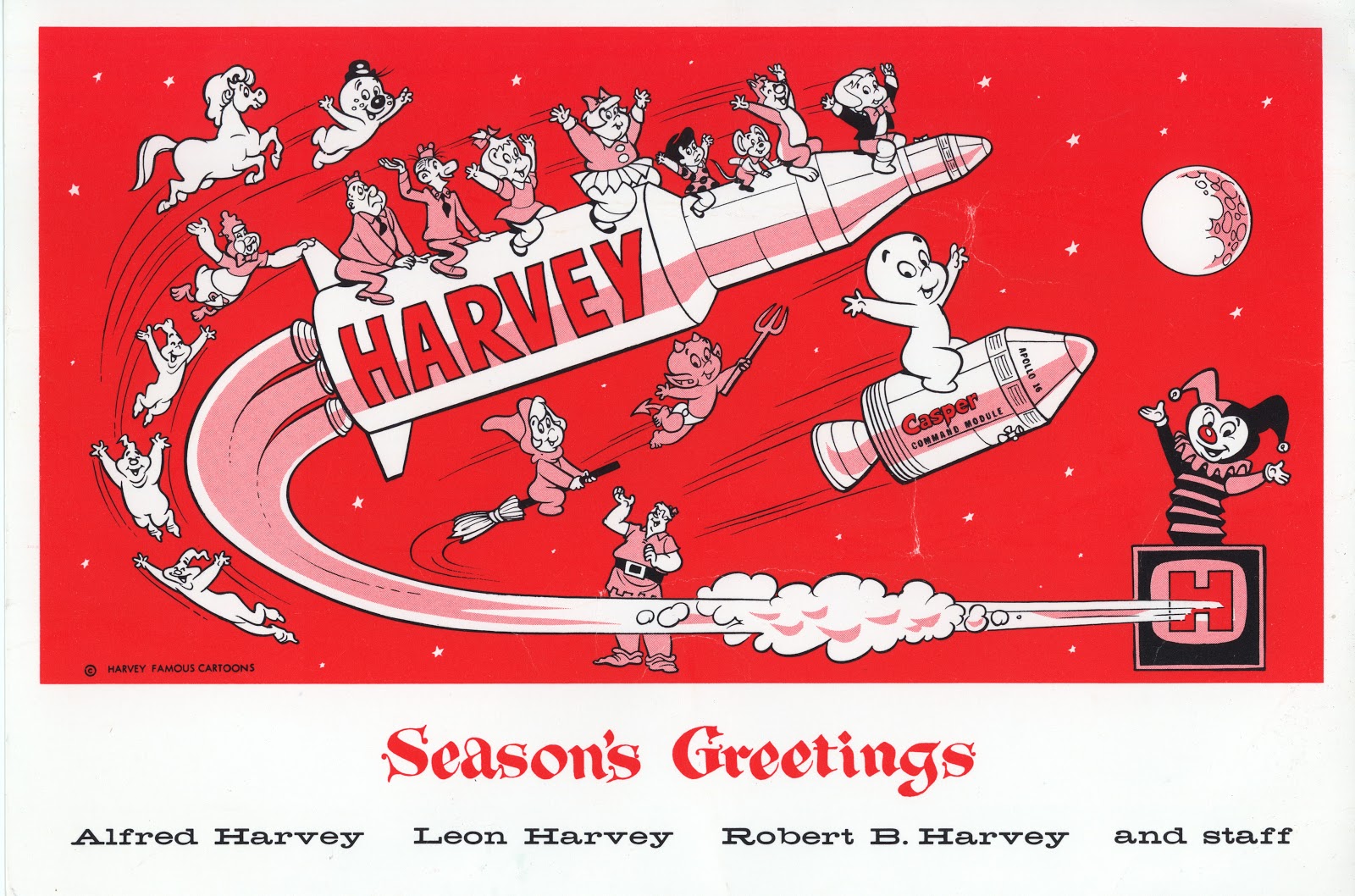
Here’s a Christmas Card sent out by the Harvey brothers featuring Famous Studios characters. During the late 1940’s and early 1950’s the Harvey brothers licensed Famous Studios characters for use in their comic books. In 1959 the Harveys purchased outright the entire line of Famous Studios characters along with related films and some other character rights. The date on this card from the Harveys is likely 1972, since Casper is riding the Apollo 16 lunar capsule that was launched on April 16, 1972. (This card was likely sent to my mother since my dad had died in 1964.)

Here’s a few more Casper story ideas that were submitted by Famous Studios staff.

This first story idea is by Izzy Klein, a member of the story department at Famous Studios. I’ve read that later he was an early cartoonist for the New Yorker as well as an animator for Disney.


This next ‘story idea’ is by ‘Tex’ Henson. ‘Tex’ had actually started out working for Disney and later moved to Famous Studios, in New York, where he worked on Casper films. He had a long career in animation with many distinctions having worked on films as diverse as Song of the South, Peter and the Wolf, and the Bullwinkle Show. He’s also credited with naming the characters Chip ‘n’ Dale, as well as teaching animation in Texas. 


The ‘story idea’ and drawings below for Minnie the Mermaid are by Larz Bourne, long time member of the Famous Studios story department. After leaving Famous Studios he worked for Hanna Barbera and DePatie-Freleng. During this later part of his career he worked on stories for many different characters, including work on the 1979 made for TV Casper Halloween Special.


The next story is Boo Bop by ‘Mike.’ Does anyone know Mike’s last name?… (Thank you everyone who commented and identified "Mike" as Carl "Mike" Myer... now he can have proper credit for this clever story idea that actually ended up in production!)


You can find the film Boo Bop, online to watch --- http://www.youtube.com/watch?v=vbDqon8-804 the story is different from other Casper films… and it’s definitely worth watching. It's clearly based on this story idea. It was produced in 1957 to play in theaters. When Harvey created the TV show Matty’s Funday Funnies, this film appears to have aired on that show along with many other Famous Studios films (Herman and Katnip, Little Audrey, etc.). If you watch this film online you’ll notice the original credits are missing. When the Harveys purchased rights to these characters and films the original credits were replaced with their own opening image. Thanks to Big Cartoon Database I can share with you the missing credits for the Casper film Boo-Bop.

Directed by Seymour Kneitel
Animated by Tom Golden and Nick Tafuri
Written by Carl Meyer
Music by Winston Sharples (and Franz Schubert)
Casper’s voice by Mae Questel (who was best known as the voice of Betty Boop)


In this case it appears that 'Mike,' who wrote the story idea, is also the one who wrote the final version used in production, and he was properly credited as Carl ("Mike") Meyer.

References:
Big Cartoon Database
Wikipedia


Sunday, September 9, 2012

CASPER…behind the scenes

Casper’s first film appearance was in The Friendly Ghost. Released in 1945 as part of the Paramount Famous Studios Noveltoon series Casper soon became so popular he earned a series of his own. He went on to star in 55 theatrical films for Famous Studios before that series ended in 1959. 

Casper, as his fans know, was a gentle ghost with no interest in scaring people. Real  ghosts mocked him for his mild manner, and humans were frightened by his translucent appearance.  But little children and animals quickly recognized that Casper only wanted to play and make friends.

Casper was unique among Famous Studios characters since he was an original creation and not based on another character (e.g Little Audrey was based on Little Lulu, and Herman and Katnip were similar to Tom and Jerry, etc.). 

In fact, there’s an interesting story about Casper’s origins (although a few details are a bit murky). Credit for Casper’s creation goes to both Seymour Reit and Joe Oriolo. In 1939 Casper was featured in a children’s book they created together. Apparently Reit wrote the story and Oriolo illustrated the character.  The story generated no interest, so while Reit was away serving in the military, Oriolo- who at the time was working for Famous Studios-- sold the character and story to Famous Studios... for two hundred dollars!!! Who could have guessed that this character would eventually inspire a whole supporting cast of ghostly characters,  that it would generate over 55 theatrical cartoons, it’s own TV show, that the character would be sold to Harvey Brothers who then put Casper in comic books—and in 1995 Universal Studios would produce a highly successful computer generated Casper film! Neither Reit or Oriolo benefited beyond the initial $200 payment. In fact disagreement developed between the two over their respective roles in Casper’s development.

Click to enlarge image
Christmas Card from Harvey's. Date unknown. Collection: Virginia Mahoney

St. John’s publishing began producing Casper comics in 1949- and in 1952 the license for Casper comics was assumed by Harvey Comics. Harvey purchased Casper (as well as other Famous characters) outright in 1959 and all these characters soon appeared on the TV show Matty’s Funday Funnies. Some of the Casper films had previously been purchased in 1956 by TV distributor U.M.&M.T.V. Corp. When these films were packaged for television the original credits were often removed and replaced with new credits that included a reference to U.M.&M.T.V. Included below is a link to one such film A Hunting We Will Go, since it’s interesting that in the screen credit where it should have read Featuring Casper the Friendly Ghost, the ‘replaced’ credits instead read Featuring Caspers Friendly Ghost.


Interesting controversies among Casper fans have to do with whether Casper is actually a dead child! And if so…how did Casper die??  At some point the ‘dead child’ concept was replaced by the concept of Casper belonging to a particular class of supernatural beings…ghosts! However when Casper appeared in Harvey Comics in the ‘60’s and ‘70’s it appeared that Casper was a ghost because his parents were already ghosts when they married. It wasn’t until the 1995 Casper feature film that the ‘dead child’ idea was revived along with an account of how Casper had died…. of pneumonia at the age of twelve due to overindulging in a day of sledding! The film even disclosed Casper’s full name… Casper McFadden.

I’m including a few typed and hand-written Casper ‘story ideas.’ These are only a few of the over seventy five Casper story ideas I found among my dads things. Story ideas could be submitted by people who worked in the story department… or by anyone else in the Studio. If a story was used one could earn a few extra dollars. I love that often the stories submitted were totally hand-written— even the typed ones were pretty messy looking when measured against today’s standards. It didn’t seem to matter---

Click on any image to enlarge
The first 'story idea' below was written by one of Casper's creators, Seymour Reit. It's two pages long and was submitted together with three other stories. The note at the top indicates that all four were purchased for $100. and adds "additional sum if any used (to make up to $300)." Not dated. Collection: Virginia Mahoney


The story idea (and drawing) below were submitted by Dave Tendlar. Dave began working at Fleischer Studios in 1931, and worked there and at its successor, Famous Studios, until the mid 1950's. He worked as both an animator and Director. After Famous Studios he continued to work in animation for a number of other studios including Terrytoons and Hanna-Barbera. Note that both pages are on pegged animation paper, and that Casper is still looking chunky (later he became more sleek). Dated Sept. 12, 1949. Collection: Virginia Mahoney


This last story idea below is by my dad, Seymour Kneitel. As the boss he was always looking for ways to keep costs down-- he's titled this "Chisel angle for a Casper picture." It involves a clever re-use of old footage. Dated Nov. 12, 1956. (Thanks to the comments below from 'J. Lee' who points out this is likely the idea for the film Ghost Writers which was released in 1958- that films on-screen credit for direction is given to Seymour Kneitel, and for writing to Jack Mercer. I would guess that Mercer may have taken this brief premise and expanded it. Staff in those days were very versatile- in additional to writing stories, Jack Mercer was an assistant animator and the voice of Popeye!) Collection: Virginia Mahoney


PS: Seymour Kneitel directed many of the Casper films- next post will be more about some of the people behind the scenes who worked on Casper films.