Sunday, October 28, 2012

HALLOWEEN BOO'S


Halloween is almost here… a good reason to visit again with Casper!
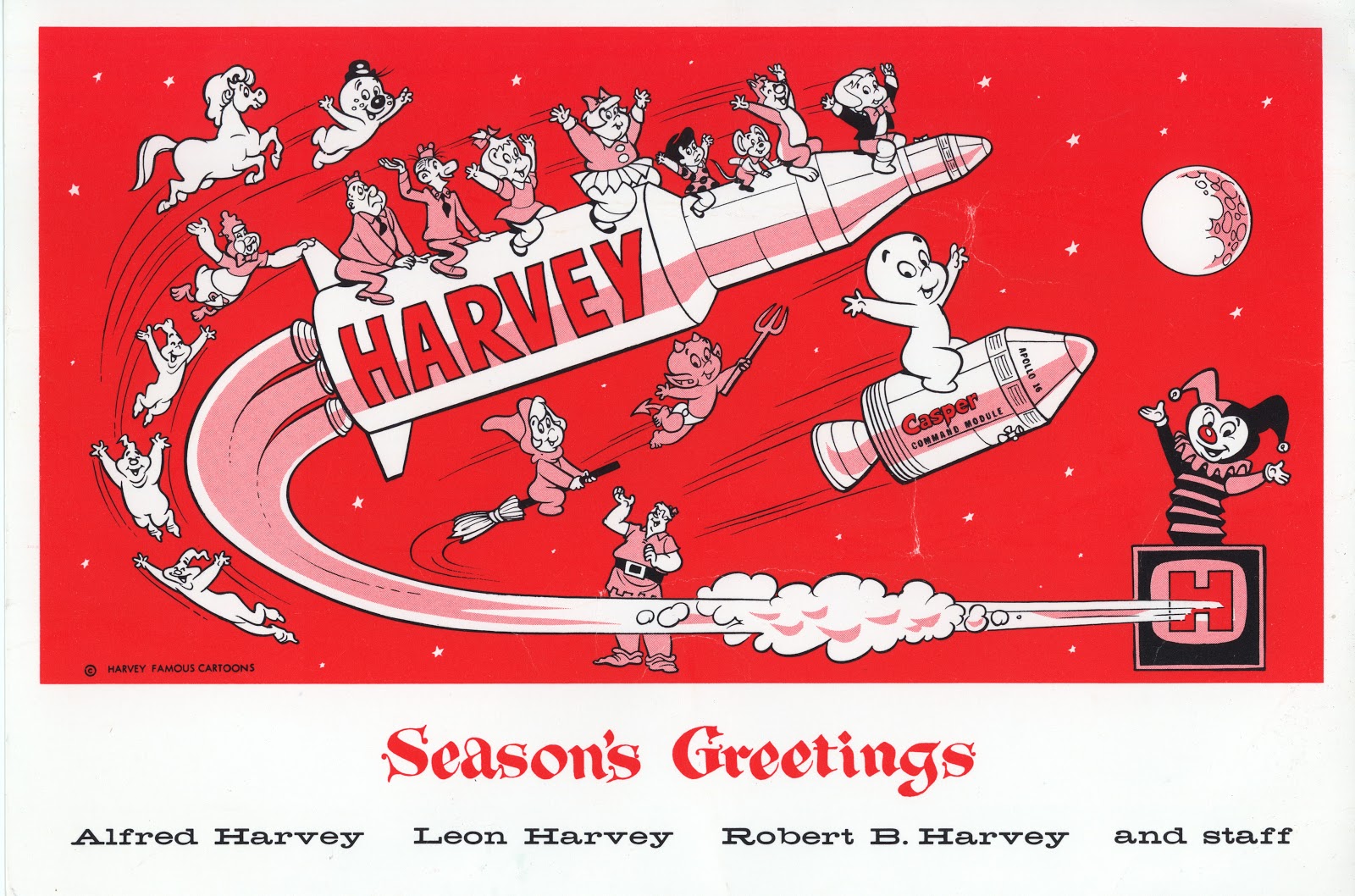

(click to enlarge images)


Here’s a Christmas Card sent out by the Harvey brothers featuring Famous Studios characters. During the late 1940’s and early 1950’s the Harvey brothers licensed Famous Studios characters for use in their comic books. In 1959 the Harveys purchased outright the entire line of Famous Studios characters along with related films and some other character rights. The date on this card from the Harveys is likely 1972, since Casper is riding the Apollo 16 lunar capsule that was launched on April 16, 1972. (This card was likely sent to my mother since my dad had died in 1964.)

Here’s a few more Casper story ideas that were submitted by Famous Studios staff.

This first story idea is by Izzy Klein, a member of the story department at Famous Studios. I’ve read that later he was an early cartoonist for the New Yorker as well as an animator for Disney.


This next ‘story idea’ is by ‘Tex’ Henson. ‘Tex’ had actually started out working for Disney and later moved to Famous Studios, in New York, where he worked on Casper films. He had a long career in animation with many distinctions having worked on films as diverse as Song of the South, Peter and the Wolf, and the Bullwinkle Show. He’s also credited with naming the characters Chip ‘n’ Dale, as well as teaching animation in Texas. 


The ‘story idea’ and drawings below for Minnie the Mermaid are by Larz Bourne, long time member of the Famous Studios story department. After leaving Famous Studios he worked for Hanna Barbera and DePatie-Freleng. During this later part of his career he worked on stories for many different characters, including work on the 1979 made for TV Casper Halloween Special.


The next story is Boo Bop by ‘Mike.’ Does anyone know Mike’s last name?… (Thank you everyone who commented and identified "Mike" as Carl "Mike" Myer... now he can have proper credit for this clever story idea that actually ended up in production!)


You can find the film Boo Bop, online to watch --- http://www.youtube.com/watch?v=vbDqon8-804 the story is different from other Casper films… and it’s definitely worth watching. It's clearly based on this story idea. It was produced in 1957 to play in theaters. When Harvey created the TV show Matty’s Funday Funnies, this film appears to have aired on that show along with many other Famous Studios films (Herman and Katnip, Little Audrey, etc.). If you watch this film online you’ll notice the original credits are missing. When the Harveys purchased rights to these characters and films the original credits were replaced with their own opening image. Thanks to Big Cartoon Database I can share with you the missing credits for the Casper film Boo-Bop.

Directed by Seymour Kneitel
Animated by Tom Golden and Nick Tafuri
Written by Carl Meyer
Music by Winston Sharples (and Franz Schubert)
Casper’s voice by Mae Questel (who was best known as the voice of Betty Boop)


In this case it appears that 'Mike,' who wrote the story idea, is also the one who wrote the final version used in production, and he was properly credited as Carl ("Mike") Meyer.

References:
Big Cartoon Database
Wikipedia


Wednesday, September 26, 2012

MORE CASPER...

Here’s some more story ideas that were submitted by Studio staff for Casper films. I thought these really good examples of how ideas could be submitted in any form--- they didn’t need to be anything fancy… like typed! Also, they're fun to read since you can really hear the voice of the writer.

This first proposal is by George Germanetti, long time Fleisher and Famous Studios animator.

Click on any image to enlarge for reading


Here’s a story idea below by Myron Waldman, another long time Fleischer and Famous Studios animator. Myron likely held the record for having worked on the most Betty Boop cartoons and was responsible for animating many Casper films as well.


The story idea below was submitted by Jack Mercer—who  though he submitted many story ideas and was also an assistant animator, is best remembered as the voice of Popeye.


If you think the story idea below looks a bit more ‘professional’- it’s because the writer, Larz Bourne, was actually a member of the story department!


I love these story ideas because they show how staffers in the 30’s and 40’s could choose to be involved in many aspects of a film... from start to finish! 

All story idea scripts: Collection of Virginia Mahoney


Sunday, September 9, 2012

CASPER…behind the scenes

Casper’s first film appearance was in The Friendly Ghost. Released in 1945 as part of the Paramount Famous Studios Noveltoon series Casper soon became so popular he earned a series of his own. He went on to star in 55 theatrical films for Famous Studios before that series ended in 1959. 

Casper, as his fans know, was a gentle ghost with no interest in scaring people. Real  ghosts mocked him for his mild manner, and humans were frightened by his translucent appearance.  But little children and animals quickly recognized that Casper only wanted to play and make friends.

Casper was unique among Famous Studios characters since he was an original creation and not based on another character (e.g Little Audrey was based on Little Lulu, and Herman and Katnip were similar to Tom and Jerry, etc.). 

In fact, there’s an interesting story about Casper’s origins (although a few details are a bit murky). Credit for Casper’s creation goes to both Seymour Reit and Joe Oriolo. In 1939 Casper was featured in a children’s book they created together. Apparently Reit wrote the story and Oriolo illustrated the character.  The story generated no interest, so while Reit was away serving in the military, Oriolo- who at the time was working for Famous Studios-- sold the character and story to Famous Studios... for two hundred dollars!!! Who could have guessed that this character would eventually inspire a whole supporting cast of ghostly characters,  that it would generate over 55 theatrical cartoons, it’s own TV show, that the character would be sold to Harvey Brothers who then put Casper in comic books—and in 1995 Universal Studios would produce a highly successful computer generated Casper film! Neither Reit or Oriolo benefited beyond the initial $200 payment. In fact disagreement developed between the two over their respective roles in Casper’s development.

Click to enlarge image
Christmas Card from Harvey's. Date unknown. Collection: Virginia Mahoney

St. John’s publishing began producing Casper comics in 1949- and in 1952 the license for Casper comics was assumed by Harvey Comics. Harvey purchased Casper (as well as other Famous characters) outright in 1959 and all these characters soon appeared on the TV show Matty’s Funday Funnies. Some of the Casper films had previously been purchased in 1956 by TV distributor U.M.&M.T.V. Corp. When these films were packaged for television the original credits were often removed and replaced with new credits that included a reference to U.M.&M.T.V. Included below is a link to one such film A Hunting We Will Go, since it’s interesting that in the screen credit where it should have read Featuring Casper the Friendly Ghost, the ‘replaced’ credits instead read Featuring Caspers Friendly Ghost.


Interesting controversies among Casper fans have to do with whether Casper is actually a dead child! And if so…how did Casper die??  At some point the ‘dead child’ concept was replaced by the concept of Casper belonging to a particular class of supernatural beings…ghosts! However when Casper appeared in Harvey Comics in the ‘60’s and ‘70’s it appeared that Casper was a ghost because his parents were already ghosts when they married. It wasn’t until the 1995 Casper feature film that the ‘dead child’ idea was revived along with an account of how Casper had died…. of pneumonia at the age of twelve due to overindulging in a day of sledding! The film even disclosed Casper’s full name… Casper McFadden.

I’m including a few typed and hand-written Casper ‘story ideas.’ These are only a few of the over seventy five Casper story ideas I found among my dads things. Story ideas could be submitted by people who worked in the story department… or by anyone else in the Studio. If a story was used one could earn a few extra dollars. I love that often the stories submitted were totally hand-written— even the typed ones were pretty messy looking when measured against today’s standards. It didn’t seem to matter---

Click on any image to enlarge
The first 'story idea' below was written by one of Casper's creators, Seymour Reit. It's two pages long and was submitted together with three other stories. The note at the top indicates that all four were purchased for $100. and adds "additional sum if any used (to make up to $300)." Not dated. Collection: Virginia Mahoney


The story idea (and drawing) below were submitted by Dave Tendlar. Dave began working at Fleischer Studios in 1931, and worked there and at its successor, Famous Studios, until the mid 1950's. He worked as both an animator and Director. After Famous Studios he continued to work in animation for a number of other studios including Terrytoons and Hanna-Barbera. Note that both pages are on pegged animation paper, and that Casper is still looking chunky (later he became more sleek). Dated Sept. 12, 1949. Collection: Virginia Mahoney


This last story idea below is by my dad, Seymour Kneitel. As the boss he was always looking for ways to keep costs down-- he's titled this "Chisel angle for a Casper picture." It involves a clever re-use of old footage. Dated Nov. 12, 1956. (Thanks to the comments below from 'J. Lee' who points out this is likely the idea for the film Ghost Writers which was released in 1958- that films on-screen credit for direction is given to Seymour Kneitel, and for writing to Jack Mercer. I would guess that Mercer may have taken this brief premise and expanded it. Staff in those days were very versatile- in additional to writing stories, Jack Mercer was an assistant animator and the voice of Popeye!) Collection: Virginia Mahoney


PS: Seymour Kneitel directed many of the Casper films- next post will be more about some of the people behind the scenes who worked on Casper films.


Saturday, August 11, 2012

SERIOUS BUSINESS...

Shown left to right: 1947 "March of Dimes" Poster Girl Nancy Drury, Seymour Kneitel holding 4 1/2 year old son  Kenny. Far right is Ken's grand-dad Max Fleischer. Taken in the Polio Ward of Knickerbocher Hospital, N.Y.C. Note the poster of Popeye on the back wall.

My dad loved his work… he loved to draw and he’d laugh hysterically at a good ‘gag.’ So it would seem that every day he’d go off to work wonderfully happy. Often he did. But like any other kind of show biz… the show had to go on and the business of animation had to go forward no matter what difficult times might be happening in your personal life.

Our family was greatly impacted—as so many others were—by the terrible polio epidemic that peaked in the 1940’s and 50’s. Worse as the summer months approached, polio struck down children as well as adults, both paralyzing and killing. Polio was second only to the atomic bomb in surveys of what Americans feared most. 

My two brothers, Tommy and Kenny, contracted polio within weeks of each other in June 1946. They were to remain in the polio ward of New York’s Knickerbocker Hospital for fourteen months receiving the only effective treatment that existed at the time, Sister Kenny hot packs.


The only time I saw them during those months was when they were taken outside on the porch pictured in the photo above. It was several stories above the ground. Periodically my parents would take me to a spot below where I could look up and wave to them. Tommy is on the bed in the very front, Kenny is in the 3rd crib back from the front.

As a parent I’ve often looked back and wondered how my dad—a devoted father—managed to every day go to the business of making cartoons with this heavy weight in his heart.


Sources:
Wikipedia
Seavey, Nina Gilden, Jane S. Smith, & Paul Wagner.  A Paralyzing Fear: The Triumph over Polio in America.  New York, New York: TV Books.  1998.  


Saturday, July 21, 2012

YET MORE PERSONAL...


Seymour’s granddaughter, Karin Kneitel, has offered to share some of the personal family items that she owns. Her father, Tommy Kneitel, was Seymour and Ruth’s first child. Tommy was born Jan. 28,1933, and is the infant/young child in these drawings.


Click on any item to enlarge
At the time of Tommy’s birth Seymour was an animator for Fleischer Studios in New York City. 


Not sure why Seymour is staying at this Brooklyn Hotel (see below). I’m speculating that since Tommy was born in a Brooklyn hospital Seymour might have moved temporarily into the Hotel St. George to be closer. In the 1930’s women had longer maternity hospital stays then they do today.  


Wow—stockings!!!  These were probably made of silk or rayon (then called ‘artificial silk’) since Nylon had not yet been invented!


Stockings still seem to be the gift of choice. Tommy looks maybe 4 or 5 years old, so these stockings are likely still made of silk or rayon. It will be a couple more years--- 1940—before Dupont makes nylon stockings commercially available.


In 1933 Fleischer Studios signed a five year contract with King Features to make Popeye films. This pencil drawing that Seymour made for Tommy probably a few years later is curious in that Popeye wears a sailor tie (not used in the comic book or film drawings of Popeye) and he has a slightly different collar treatment. 


Done in 1938 or ’39, this is a drawing by Tommy himself! Seymour writes: “I showed Tommy a pencil-test of Gulliver- where a derrick was trying to lift his foot- he didn’t say anything but drew this picture and showed me it- Good isn’t it—Seymour.” Note that this drawing is on Fleischer Studios animation paper that uses the Fleischers distinctive hole punch system at the top.


Since this letter mentions visiting the Worlds Fair it must date from either 1939 or 1940. As I’d mentioned in an earlier post- Seymour and family were often separated with one in New York and the other in Florida (or vice versa)—with Seymour often traveling between the two locations. At this time the Studio was in Florida and a number of filmmaking activities that were not supported in that Miami location had to be carried out in New York.

A cute drawing by Seymour showing Tommy thanking ‘Max’ for a check. ‘Max’ is Tommy’s grandfather, Max Fleischer. 

Here’s a letter from Max Fleischer to grandson Tommy dated Jan. 1944. Max by this time was commuting between New York and Detroit while directing animation for the Jam Handy Organization. Here Max draws himself as a ghost carrying a corned beef sandwich!

Thanks for sharing these Karin!


Monday, June 18, 2012

HAPPY ANNIVERSARY!!

Collection: Virginia Mahoney

Here’s another special occasion card made by a Famous Studios artist for my parents 25th wedding anniversary… which would date this from December 1956. My parents met while both were working at Fleischer Studios and they became one of the many studio romances that led to marriage. 


The signatures on this card are a good survey of some well known people working for Famous Studios in the 1950’s...


Al Eugster, Dave Tendlar, Nick Tafuri, Tom Johnson, and William Henning were long time animators—all had worked for both Fleischer and Famous Studios—as well as other studios. Bob Little and Liesel Howson, also long time employees, painted the animation backgrounds. Leonard McCormick was responsible for camera work and Win Sharples scored music for the cartoons. Jack Mercer was best known as the gravelly voice of Popeye….. Ellsworth Barthen and Mike Myer were story writers……and Mina Morrisey was Head of cel painting. Just to mention a few……

Tuesday, May 22, 2012

GETTING PERSONAL...


My dad was always in an animation state of mind. He didn’t turn it off when he came home at night.  He would get hysterical over a good ‘gag’ or joke  (before the days of e-mail good jokes were widely shared in person with the re-telling of it a craft in itself). Sitting at the dinner table was an occasion for dad to gather input from the family for anything he might use at work. In fact, if we suggested a corny cartoon title that was used, we could earn five dollars!  This generated a lot of hackneyed one-ups-manship between my two brothers, mother and myself. My brother Tommy swore he came up with the idea for the character ‘Goodie the Gremlin’ and he never got paid!! (Goodie starred in four Noveltoons, the first appeared in 1961.)

In addition, all kinds of life events were acknowledged with  one of a kind creations.  Here’s a selection of some of these unique drawings made by my dad, Seymour Kneitel. 
I especially like the one above made for my mother… it shows that humor at our house was neither high-class nor subtle.


A Valentine for my mother has a bit of a spelling problem, but love the sentiment.  In 1937, while Seymour was working for Fleischer Studios, the studio relocated to Florida. During and after that re-location there were many times when one of my parents might be in New York and the other in Florida.  Besides several separations during the complex New York to Florida move, there were a number of film production activities not supported in Florida that required Fleischer staff traveling to New York.

Envelopes and letters were great places for a drawing...


The P.S. in the letter “Give my regards to Bimbo” is a reference to a real life dog they had called Bimbo.

These last three drawings are all on Fleischer Studios animation paper.  When these drawings were done, animation studios each had their own preference as to the size of the paper, the type of paper, and the system of holes at the top that held the paper in place.  Details such as these can be useful in identifying from which studio a drawing might have originated.  The drawings below were made between 1931 and about 1938 during the time Fleischer Studios used this distinctive paper... 8.5” x 11” sheets punched with three holes at the top that fit their unique animation peg system. This paper was made specifically for them by Hammermill and is watermarked ‘Management Bond.’


This drawing on Fleischer animation paper looks like they’re temporarily separated again!


This must refer to changes around the house after the birth of first son, Tommy… which would date this and the drawing below about Feb. 1934.


Here's a sketch made about the same time.. interesting to speculate on where he was going with this...


I back-lit and enlarged one of the drawings (below) to show the ‘Management Bond’ watermark.  The Fleischer’s continued to use this type of paper until about 1938 during the making of Gulliver’s Travels.


All items, letters, envelopes, drawing in this section: Collection of V. Mahoney